Crossing
The crossing of two binary individuals is a process that generates two new individuals for the population and discarding the two parents. This can be done in various ways this library has methods for the following:
Single point crossover
Two point crossover
Uniform crossover
Implementation of the crossing methods
Single point crossover
The single point crossover is the most common method of crossing. It takes two individuals and a random point in the genome and swaps the genes after that point between the two individuals. This is illustrated in the following figure:

Two point crossover
The two point crossover is similar to the single point crossover, but instead of swapping the genes after one point, it swaps the genes between two points. This is illustrated in the following figure:

Uniform crossover
The uniform crossover is a method that swaps the bits between two individuals with a probability of 0.5 per bit inside the individual. This is illustrated in the following figure:

Difference between the crossing methods
The difference between the crossing methods can be classified by the amount of similarity between the parents and the children. The single point crossover and the two point crossover are similar in the sense that the children are similar to the parents. The uniform crossover is different in the sense that the children are not similar to the parents. This is illustrated in the following figure:
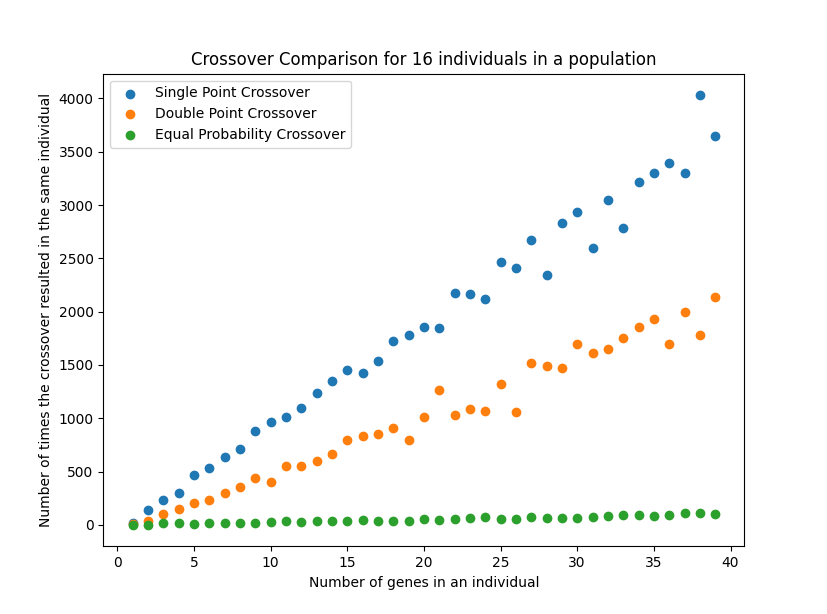
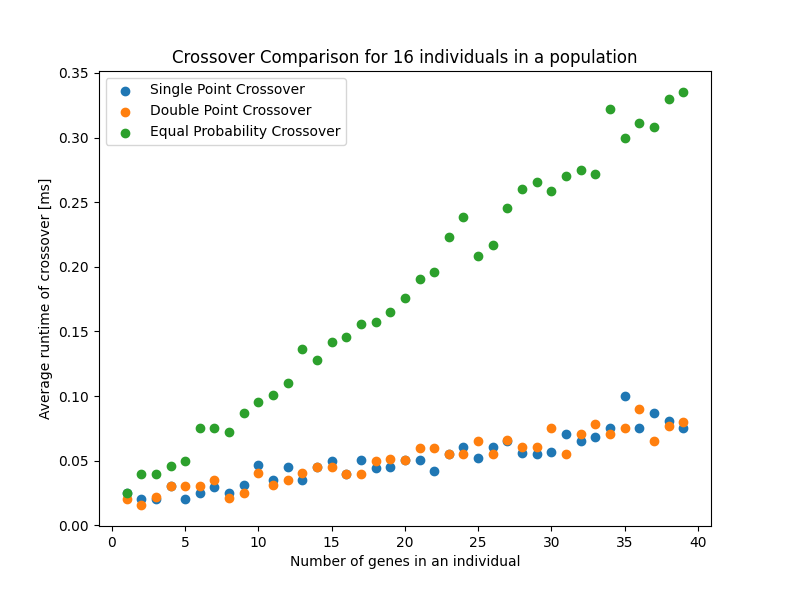
The time complexity of the crossing methods is the same, since they all have to loop over the genes in the genome. The space complexity is also the same, since they all have to allocate a new array for the children.
A figure with the time complexity, in python, of the crossing methods can be found below:
Differences between Python and C implementations
The Python and C implementations of the crossing methods are very similar. The main difference is that the C implementation requires the result array to be preallocated, and the amount of genes with their respective bitsize to be passed as arguments. The Python implementation does not require this and returns a new array with the result.
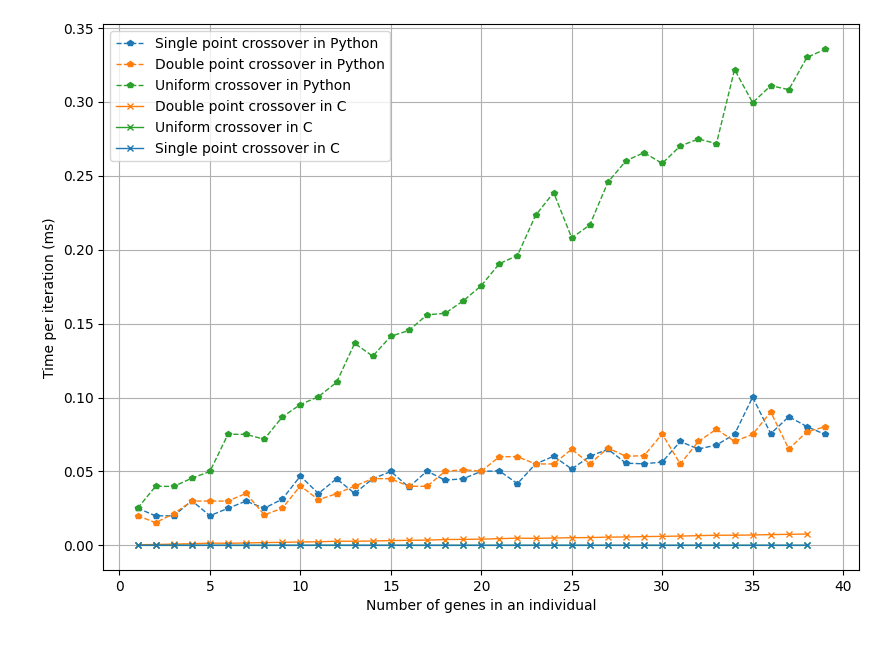
Another difference is the speed of the implementations. The C implementation is much faster than the Python implementation, a comparison of the speed can be found in the following figure:
There is also a difference in between the time complexity of the three methods in C, this is illustrated in the following figure:
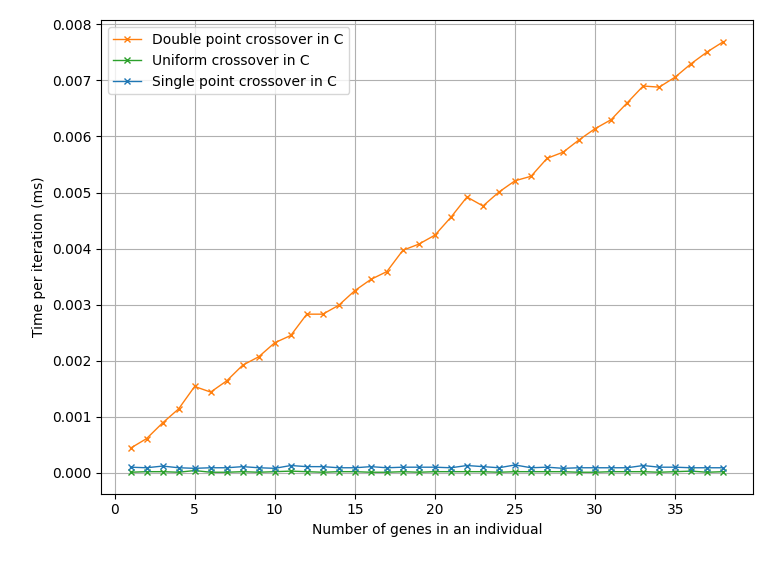
With the fastest methods being uniform and single point crossover, and the slowest method being the two point crossover. The figure below zooms in on the fastest methods:
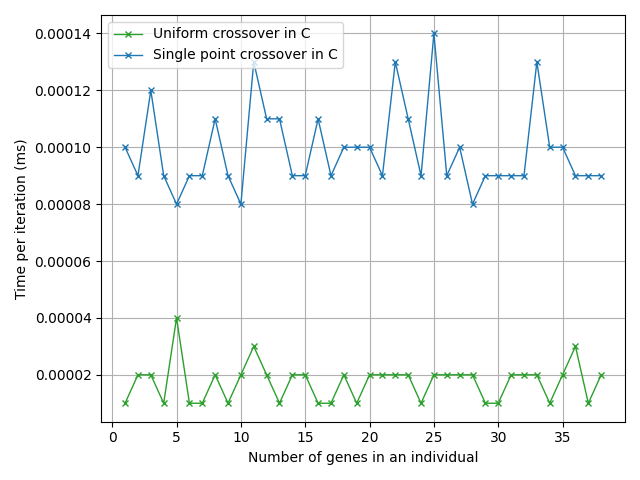
These interesting results are caused by the way the methods are implemented in C and Python. The Python implementation of single and double point crossover are vectorized, which means that they are implemented in a way that they can be applied to the whole population at once. The uniform crossover is not vectorized, which means that it is applied to each individual in the population with an expensive for loop.
In C the double point crossover needs to make sure that the second point is after the first point, which is done with an if statement. This if statement is the cause of the double point crossover being slower than the single point crossover. The uniform crossover is the fastest method in C, because it does not need to check if the points are in the right order.